New: the Open Benefits Report 2026Free for every employerIn your inbox on 7 DecemberNew: the Open Benefits Report 2026Free for every employerIn your inbox on 7 DecemberNew: the Open Benefits Report 2026Free for every employerIn your inbox on 7 DecemberNew: the Open Benefits Report 2026Free for every employerIn your inbox on 7 DecemberNew: the Open Benefits Report 2026Free for every employerIn your inbox on 7 December
Sign up
Back to overview
Client story

From 100 pages of collective agreement to understandable benefits

Achmea is the largest insurance group in the Netherlands, known for brands such as Centraal Beheer, Interpolis and Zilveren Kruis. With thousands of employees, the organisation continuously invests in attractive and future-proof employment practices.

Despite a comprehensive benefits package, employees did not always find it easy to locate key schemes and provisions. Achmea therefore wanted to make its benefits Communication more accessible and to leverage it more effectively when onboarding new colleagues.

From 100 pages of collective agreement to understandable benefits
We had been looking to improve the way we communicate about our benefits for quite some time, both to potential new colleagues and for internal communications. With the help of Not Secondary, we achieved just that. What's great is that an expert outside perspective helps you communicate just that little bit differently and arrive at a concrete end product. Working with Paul was a real pleasure. We're absolutely delighted with the result. Finally, a powerful new tool to showcase our excellent benefits.
Ad van Zonneveld , HR Journey Lead @Achmea
Industry: Verzekeraar, Financiële diensten.Number of employees: 13.000 +

Challenge: Achmea wanted to improve the way it communicates about benefits.

Although the organisation offers a comprehensive and attractive benefits package, employees and job applicants often found it difficult to quickly gain insight into the benefits relevant to them.

The challenge was to present the most important benefits from a company collective labour agreement of over 100 pages in an accessible and engaging way, without losing sight of content quality and completeness.

In addition, Achmea wanted to make benefits a more prominent part of its recruitment communications and employer branding.

Approach & advice: The first step was a thorough inventory of the benefits arising from the company collective labour agreement.

We then assessed which benefits are most relevant to employees and job applicants, and which elements best align with Achmea's employer value proposition.

Alongside the benefits themselves, we also examined the organisation's mission, vision and core values. Based on this, we developed a structure in which the benefits were organised around themes that reflect what Achmea values as an employer.

This approach ensured that not only the benefits were made visible, but also the story behind those benefits and Achmea's identity as an employer.

The result was a visually compelling eleven-page Benefits Statement, bringing together benefits, employer identity and organisational character in one clear document.

Result: The result is an accessible communication tool that allows employees and job applicants to quickly gain insight into Achmea's most important benefits.

Where previously a great deal of information was scattered across an extensive collective labour agreement, the Benefits Statement now provides a clear and concise summary of the benefits most relevant to employees.

In addition, Achmea now has a communication tool that can be used not only for internal communications, but also to support recruitment and employer branding.

By bringing together benefits, employer value proposition and organisational identity in a single document, the benefits have become more visible, easier to understand and more appealing to both current and prospective employees.

Latest Insights

Discover the latest articles on secondary benefits and how to deploy them strategically.

Frequently Asked Questions

Find answers to the most common questions about our services and solutions.

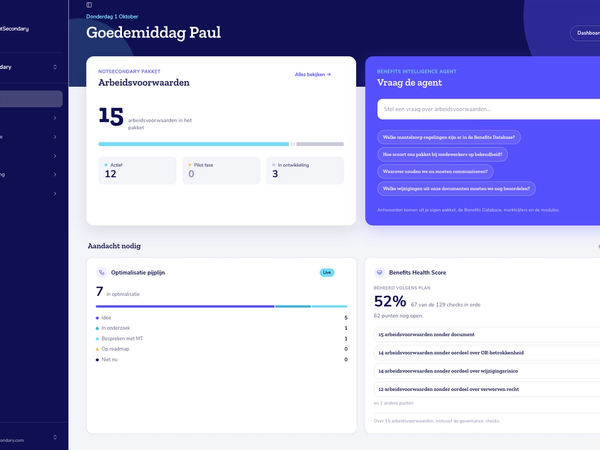
Total Benefits is the first benefits intelligence platform in the Netherlands. It brings an organisation’s entire benefits package together in one central environment and helps employers structure, compare, improve and monitor their benefits.

Unlike traditional HR software, Total Benefits is not focused on HR administration or payroll processing. The platform is dedicated entirely to employee benefits, combining information about your own benefits package with market data, practical insights and intelligence.

With Total Benefits, you can:

  • centrally document and manage your entire benefits package;
  • access a Benefits Database containing more than 200 different employee benefits across 12 themes;
  • compare benefits using available benchmark data;
  • identify opportunities and explore potential improvements;
  • monitor governance, accuracy and changes to your benefits;
  • compare information from different sources using Benefits Sync;
  • combine insights from benchmarks, trends and other data sources to make better-informed decisions.

The aim is not for organisations to simply offer more benefits. Total Benefits gives employers the information and context they need to make better, more informed decisions about their benefits package.

This creates one central and increasingly rich source of information about employee benefits, which can be used not only by HR, but also by HR Business Partners, recruitment, communications and management.

In short: Total Benefits helps you understand what you offer, how you compare and where opportunities or risks lie – so you can make informed decisions about what to do next.

The name Total Benefits is derived from the well-known HR concept of ‘Total Reward’: the total value an employer offers its employees, from salary and benefits to development, culture and the overall employee experience.

Because we focus specifically on everything beyond salary, we chose the name Total Benefits.

Within the platform, we look at employee benefits across twelve core themes, such as wellbeing, mobility, flexibility, sustainable employability and meaningful work. This creates structure and coherence across the entire benefits package.

From this central source of information, organisations can structure, compare, improve and monitor their employee benefits. By combining information about their own benefits package with benchmark data, practical insights and trends, organisations gain the intelligence they need to make better-informed decisions about their benefits.

Benefits Intelligence is the process of collecting, combining and applying knowledge, data and market insights related to employee benefits.

Total Benefits combines information about an organisation’s own benefits package with benchmark data, practical insights, trends and other relevant sources. This provides insight not only into what an organisation offers, but also how its benefits compare to the market, where opportunities or risks lie, and which developments are relevant.

Benefits Intelligence forms the foundation of Total Benefits. It helps organisations not only manage their employee benefits, but above all make better-informed and better-supported decisionsabout their benefits package.