Total Benefits Update #2 | Q3 2026
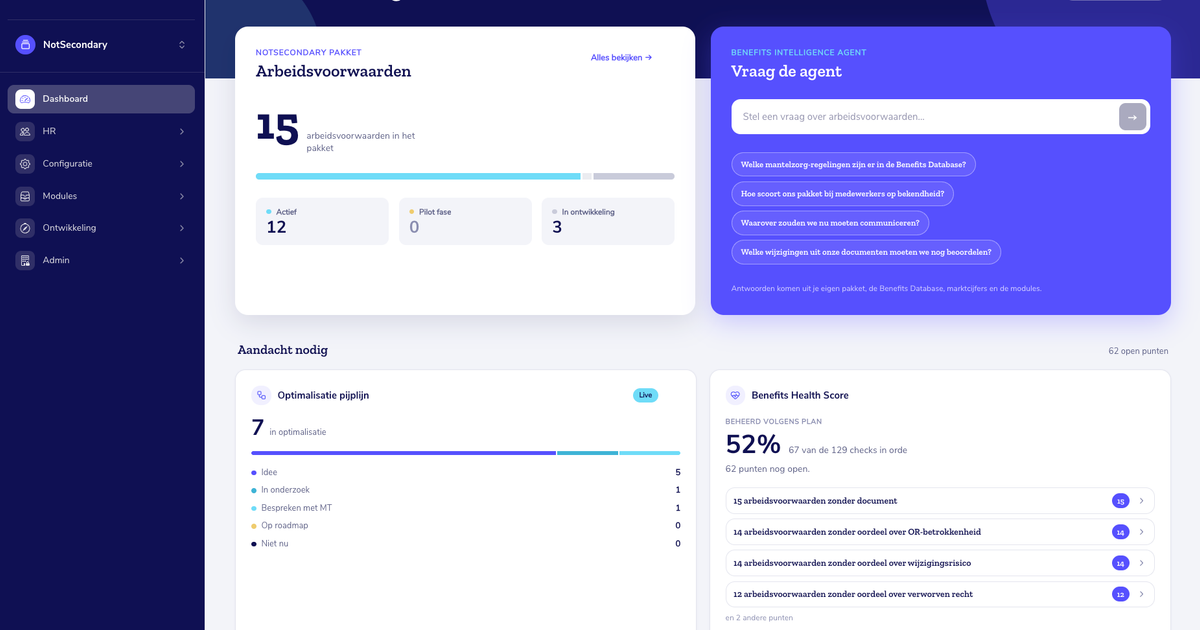
Over the past few months, we have continued to make significant improvements to Total Benefits. Alongside new features such as Benefits Sync and the Benefits Health Score, we have redesigned the dashboard, further integrated the Benefits Database with employers' own benefits packages, and completely overhauled our pricing structure.
In this quarterly update, we take you through the key developments of Q3 2026 and look ahead to what's coming next.
Further developing our vision, positioning and pricing
In our previous quarterly update, we shared our vision for Total Benefits in detail and introduced a new pricing structure with three packages: Foundation, Growth and Enterprise. We have since concluded that this was not the right decision.
We realised that this structure did not sufficiently reflect how employers want to use Total
Benefits. Some organisations primarily need comprehensive benchmarking information, while others benefit more from additional data sources or features that support benefits management. By dividing these capabilities into three predefined packages, we were limiting the very flexibility we want to offer employers.
That is why we have completely redesigned our pricing structure. Total Benefits pricing is now based on the complexity of the organisation and the data sources an employer wants to use to analyse, benchmark and improve its benefits package. The number of sources connected to Total Benefits also plays a role in determining the price.
We have removed the number of users as a pricing factor altogether. Every organisation can now give unlimited colleagues access to Total Benefits, allowing HR, Compensation & Benefits, recruitment, management and works council representatives, for example, to work with the same information from their respective roles.
With our new pricing configurator, employers can put together their preferred setup. The price is displayed immediately, including the impact of additional modules, entities and data sources.
This change reflects our broader vision for Total Benefits: a single, central intelligence and management platform for the entire benefits package, designed to grow alongside an organisation's needs and complexity.
New in Q3 2026
Benefits Sync: no duplicate administration
One of our most significant new developments is Benefits Sync. Within organisations, benefits information is often spread across multiple locations. The benefits package may be recorded in Total Benefits, while the official information is documented in an employee handbook, collective labour agreement or separate benefits policy. But what happens when one of these documents changes?
With Benefits Sync, employers can upload new versions of their benefits documents. Total Benefits then compares them with previous versions and the current benefits package. Potential changes, such as an adjusted amount, an amended benefit or a new policy, are automatically identified and submitted for review. Employers always remain in control of which changes are actually implemented.
Benefits Sync also works in the other direction. When a benefit is added or amended in Total Benefits, the platform can track whether that change still needs to be reflected in the official documentation. It can generate an initial draft of the required wording and check during a subsequent review whether the change has been incorporated into the relevant document.
The first version of Benefits Sync works with documents, but we plan to expand this functionality to other information sources in the coming period. One of the sources we want to connect is an employer's careers website. This will allow us to check whether the benefits presented to prospective employees accurately reflect the policies and arrangements actually offered by the organisation.
Benefits Health Score: know where attention is needed
The Benefits Health Score is a new addition to the dashboard. It provides insight into how comprehensively and systematically an organisation's benefits package has been documented and highlights areas that may require attention.
Among other things, we look at how up to date the information is, ownership, governance and ongoing management. For example, the score may highlight benefits that have no linked source document or for which matters such as works council involvement, amendment risks or acquired employee rights have not yet been assessed.
The Benefits Health Score is not a rating of the quality of the benefits themselves. Instead, it is a tool that helps identify opportunities to strengthen the management of the benefits package. We will continue to refine and expand this functionality over the coming period.
Improved in Q3 2026
A personalised dashboard for every user
The Total Benefits dashboard has been redesigned and can now be personalised. Every user can decide which information is relevant to them and which components appear on their homepage.
For example, an HR professional primarily focused on optimisation can place the optimisation pipeline at the centre of their dashboard, while a colleague responsible for benefits management and governance may prefer to give greater prominence to the Benefits Health Score.
Using the Customise Dashboard feature, each user can easily choose which components to display. This allows Total Benefits to better accommodate the different roles and responsibilities within an organisation.
From inspiration to implementation, faster
We have also improved the connection between the Benefits Database and an organisation's own benefits package.
The Benefits Database contains more than 200 benefits across twelve categories. When an organisation discovers an interesting benefit, it can now add it directly to its own package. Employers can choose an existing implementation option from the database or document their own approach.
Benchmarking information is also becoming increasingly comprehensive. This allows employers not only to assess how their existing benefits compare with the market, but also to explore market data for benefits they do not currently offer.
As a result, the journey from discovery and comparison to optimisation and implementation is becoming increasingly streamlined.
Looking ahead to Q4 2026
In the coming period, we will continue developing Benefits Intelligence. Our focus will be on expanding the available information sources and creating stronger connections between insights from an organisation's own benefits package, benchmarking information and other relevant data.
With Employee Voice, we want to give employees a greater say in decisions about benefits. This module is being developed to enable employers to ask targeted questions throughout the year about, for example, the importance, awareness and perceived value of specific benefits.
Company Voice focuses on helping employers communicate their benefits more effectively and strategically, both to existing employees and prospective candidates. Among other things, we want to build on the planned connection between Benefits Sync and employers' careers websites. While Benefits Sync will help verify that published information is accurate, Company Voice will help employers identify which benefits deserve greater visibility.
For example, Company Voice could suggest benefits worth highlighting in job advertisements because benchmarking information shows that they differentiate the employer from others in the market. Our aim is not only to help employers communicate their benefits accurately and keep that information up to date, but also to make better use of the opportunities their existing benefits package offers.
We are also working on Benefits Trends, which will provide employers with insights into relevant market developments, while continuing to expand our benchmarking data. In addition, we are further developing Benefits Intelligence to create stronger connections between the different information sources within Total Benefits.
We also plan to expand Benefits Sync to support additional types of sources. This will allow employers to incorporate more benefits information from their existing systems, documents and communication channels into the management of their benefits package.
Final thoughts
The developments of the past quarter mark another step forward for Total Benefits. While the platform initially focused primarily on structuring, benchmarking and optimising benefits, we are now providing employers with increasingly comprehensive support for keeping their benefits packages up to date and managing them effectively.
Our revised pricing structure reflects this development. Employers can choose the data sources and features they need without being restricted by predefined packages or user limits.
With these developments, we continue working towards our core ambition: helping employers not only understand what they offer, but also see how they compare with the market and identify where attention is needed.
Curious about the latest developments? Explore Total Benefits or schedule a demo. We would be happy to show you how the platform can help your organisation manage and continuously improve its benefits package.