After the Summer: Time for a Fresh Look at Your Employee Benefits Package

For most people, the summer holidays are over. Calendars are filling up again, projects are restarting and plans that were put on hold before the summer are finding their way back onto the agenda. In many organizations, September almost feels like a second January. As far as we're concerned, it's also an excellent time to take another good look at your employee benefits package.
Not with the intention of immediately introducing all kinds of new benefits, but rather to take a fresh look at what you already offer. Which benefits are working well? Which ones may have become outdated? What signals have employees shared over the past period? And where are the opportunities to further improve your package towards 2027?
Optimization Doesn't Start with Adding Something New
When we talk about optimizing employee benefits, attention quickly turns to new policies and benefits. A workation policy, flexible public holidays, extended bereavement leave or perhaps a new wellbeing budget. All interesting topics, but in our view, they shouldn't be the starting point.
Start with the package you already have. Many employee benefits were introduced at some point and have barely been reviewed since. Allowances may no longer reflect current costs, policies may no longer fully align with the organization as it is today, or there may be benefits that no one really remembers the original reason for introducing. So first ask whether all your benefits are still relevant, whether they fit your current workforce, whether they are actually being used and whether they still reflect what you want to stand for as an employer.
Optimization doesn't automatically mean expansion. Sometimes the biggest improvement comes from adjusting or simplifying an existing benefit. And sometimes you may conclude that a benefit no longer fits the organization at all.
What Have You Heard Over the Past Period?
In our view, assessing an employee benefits package solely from an HR perspective isn't enough. Ultimately, what also matters is how employees experience the package. Chances are your organization already has plenty of information that can provide insight into this. Think of employee engagement surveys, recruitment conversations, exit interviews, discussions with the Works Council or simply the questions HR receives on a regular basis.
In the employee focus groups we conduct, we see how valuable it can be to specifically discuss employee benefits. Benefits that employers assume are highly valued sometimes turn out to be barely known. At the same time, employees regularly raise needs that weren't yet on the organization's radar. September is therefore a good time to bring those signals together again. Which topics keep coming up? Where is there dissatisfaction? Which benefits are particularly valued? And where is there a gap between what you as an employer believe is important and what employees actually experience?
That doesn't mean every employee request should immediately be accommodated. Employee input is one of the sources you can use to shape your benefits strategy, alongside factors such as organizational strategy, costs, legislation and developments in the labour market.
Compare Your Employee Benefits with the Market Again
Because the employee benefits market doesn't stand still either. Benefits that were distinctive a few years ago may have become much more common by now. At the same time, new benefits are emerging and existing policies are changing in response to societal, fiscal and technological developments.
In our previous article, for example, we discussed five employee benefits that we're seeing appear on the agenda more frequently in 2026: flexible public holidays, extended bereavement leave, military reservist policies, workations and generational pacts. That obviously doesn't mean you should immediately introduce all five. It does, however, make sense to periodically assess how your package compares with the market.
And look beyond the question of whether other employers offer a particular benefit. The way a benefit is structured often makes all the difference. An employer that allows employees to work abroad for five days technically offers the same workation benefit as an employer that allows employees to work abroad for four weeks. In a simple benchmark, both receive the same tick, even though in practice these are two very different policies. A good benchmark should therefore tell you not only what employers offer, but also how they offer it.
Start Looking Ahead to 2027
September is also a logical time to start looking ahead to the next calendar year. 2027 may still seem some way off, but a few months isn't actually that long when preparing more substantial changes to employee benefits. A proposed change may need to be financially assessed, legally reviewed or discussed with the Works Council. Policies then need to be updated and employees should be informed clearly and on time about what is changing.
On top of that, Prinsjesdag, the Dutch government's annual Budget Day, is just around the corner. The plans presented there may have implications for tax arrangements, allowances and other elements of employee benefits packages. Not every announced proposal will ultimately be implemented and not every development requires immediate action, but it is a logical moment to compare upcoming fiscal and legislative developments with your existing package.
Starting in September also gives you enough time to explore different scenarios and prepare decisions carefully. If you only start thinking about changes for 1 January in December, you're making things unnecessarily difficult for yourself.
Make Optimization a Continuous Process
Taking a fresh look at your package will probably result in a list of topics that deserve attention. The temptation may be to tackle everything at once, but there's no need to do so. Some improvements can be implemented relatively easily, while others first require benchmarking, financial analysis or additional employee input. Larger changes can then become part of your plans for 2027 or even further ahead.
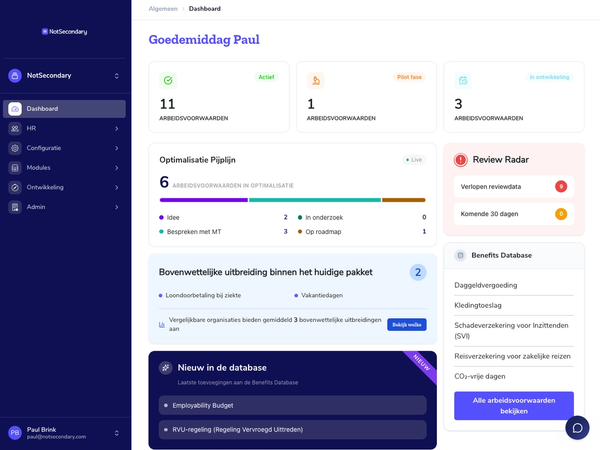
That's why we like to work with an optimization roadmap that brings these topics together and helps prioritize them. This prevents employee benefits from only being changed when a question happens to come from an employee, manager or the leadership team. Instead, you create a continuous process in which you periodically assess where your package stands and where improvement may be possible or necessary.
And perhaps, after completing that assessment, you'll conclude that no major changes are needed at all. That's valuable information too. Optimizing simply for the sake of being able to say you've introduced something new should never be the objective.
A Fresh Perspective for the Final Quarter
A fresh start for your employee benefits package doesn't mean introducing five new benefits immediately after the summer. September is a good time to zoom out and take another look at what you already offer, what employees think about it, how your package compares with the market and which developments are coming your way.
From there, you'll naturally get a clearer picture of where the real opportunities lie. Perhaps that means introducing a new benefit, perhaps an existing policy needs improvement, or perhaps the biggest opportunity is simply communicating more effectively about something you've already been offering for years.
And if your employee benefits package is actually in great shape already? Then that may be the best possible conclusion with which to start the final quarter of the year.