The basics in order: what must not be missing from your benefits package

Employers love offering benefits that are 'flashy', the kind that make you stand out, or even steal the spotlight. One of the most common questions I get when I'm at an event or talking with HR professionals is: "What's the most outrageous benefit you've ever come across?"
But are those "most outrageous" benefits actually the ones that make you score as an employer? Or do employees look at the must-haves first, with the extras only coming after?
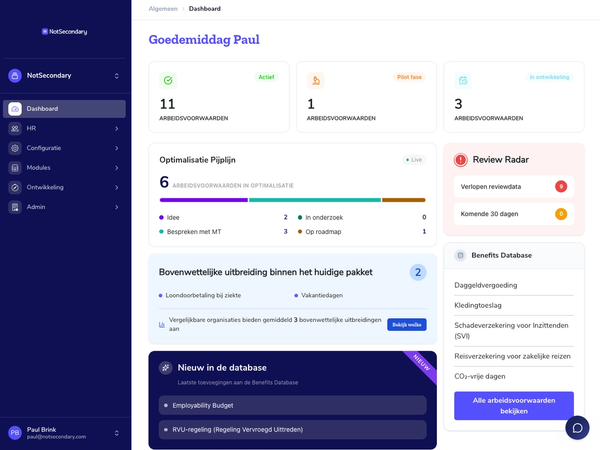
In this article, I explore which benefits an employer absolutely needs to have in place to be able to speak of a solid package. I do this using 12 benefits-related themes that we frequently use during Optimisation and Communication projects. They also form the foundation of ourBenefitsDatabase: a component of the SaaS solution we're currently building, which will be available to employers from 1 January 2026.
Disclaimer: Since we're talking about secondary benefits here, I'm leaving primary conditions (such as salary) out of the equation. That those need to be in order goes without saying, of course.
1. Financial security
If this isn't properly arranged, the entire foundation of your benefits package collapses. You can offer the most hyped benefits out there, but if employees feel they can't provide for themselves, now, soon, or down the line, things fall apart quickly.
This theme covers provisions that offer security: now, later, further down the road, and in case of illness. Thinkpension,insuranceand, very importantly, above-statutory continued pay during illness. Did you know, for example, that eight out of ten employers in the Netherlands pay employees their full salary during the first year of sick leave? See this article → https://arbeidsvoorwaardennieuws.nl/news/801/acht-op-de-tien-werkgevers-betaalt-zieke-medewerker-volledig-door-in-eerste-ziektejaar
For younger employees in particular, this can feel like something that doesn't concern them yet. But when the moment arrives, you'll be glad it's all properly taken care of.
2. Sufficient leave days & work/life balance
Once the financial foundation is solid, the need for adequate rest typically follows immediately. Employees want to enjoy the fruits of their labour.
In the Netherlands,25 days of annual leaveis often considered the minimum to remain attractive, depending on the sector. In organisations where billable hours are central, annual leave days are relatively costly. In other sectors (such as financial institutions, for example), there is often more room for additional days.
Great value is placed on flexibility in leave: being able tobuy or sell holiday days,sabbaticals, or evenworkationsare becoming increasingly popular.
3. Flexible options
Offering employees the flexibility to make their own choices during certain phases of life genuinely belongs in a modern benefits package. That flexibility comes in many forms: from hyper-personalised choices to arrangements that employees can tailor themselves.
Hyper-personalised solutions often involve technology: you want to allow employees to make real-time choices that are immediately visible in, for example, a budget or balance.
Is that still a step too far right now? Then I advise organisations to at least start with flexibility in:
- Leave(think buying or selling holiday days)
- Holiday allowance(not automatically in May, but whenever the employee wants it)
- Public holidays(ideally available to use flexibly)
That last option, public holidays, also touches on the theme of diversity, which is a nice bonus.
In summary: a good, solid package gives employees something to choose from.
4. Mobility covered
Once everything above is in place, you'll naturally also want to make sure employees can get from A to B comfortably.
Ideally, you do this through amobility budget. But individual options such as a goodpublic transport scheme,lease bicycle,company car, or acycling mileage allowancecan add considerable value too, and score points on vitality and sustainability as well.
As mentioned earlier, we have categorised all benefits in the Netherlands into 12 themes, with some overlap at times. A lease bicycle, for instance, straddles mobility, green benefits, and vitality.
Not every company needs to excel across all 12 themes. But a solid benefits package starts with a strong foundation.
Hopefully this article gives you a useful framework for (re)designing your benefits package. Curious about all 12 themes? Or would you like to brainstorm about the structure of your package? Feel free to send me a message.