The role of stakeholders in the benefits package, Part 2

The role of stakeholders in the benefits package, Part 2

Benefits affect everyone in the organisation. But not every benefit has the same impact, and not every stakeholder needs to be involved at the same time. A workation, for example, directly concernsIT and Security, while an unpaid leave scheme is primarily relevant toPlanning.

In this three-part series, I walk you through the most important stakeholders in benefits projects:

  • Part 1: HR, Leadership & Management and Communication/Branding
  • Part 2: Finance, Legal, IT & Technology, Facilities
  • Part 3: Planning, Learning & Development, External Service Providers, Employees/Works Council

For each stakeholder, I explain: when to involve them, what their role looks like, and what to keep in mind when implementing new or updated benefits.

šŸ“ŠFinance

The financial impact of benefits on organisations is significant. It therefore makes sense that Finance is a key stakeholder in benefits projects. Think of modelling new benefits, simulating scenarios, and providing cost data on existing schemes.

That's why we always bring Finance on board from the outset and include them in the project team we put together.

🧾Legal

A stakeholder very comparable to Finance. Legal expertise is essential when reviewing the benefits package, as the consequences in implementation can be far-reaching. We always say: the beauty of benefits is that there is ample room for customisation and differentiation. At the same time, that also means careful consideration must be given to how a benefit is offered to the employee and whether it is legally sound.

šŸ’»IT & Technology

This stakeholder has a dual role. IT & Technology needs to be involved in the substance of certain schemes, for example, when employees start working remotely. They also play an important role in execution. Which portal do employees use to spend their home office budget? How do they flag that a candidate has come in through a referral? And can IT help automate these processes?

🧱Facilities

The role of Facilities is becoming increasingly important. With the popularity of remote working, getting employees to come into the office has become more of a challenge. A welcoming office as a place to connect, rather than simply a place to work, is therefore becoming an ever more important benefit. Facilities are also increasingly involved in initiatives such as an in-house gym, company lunches, or after-work drinks.

From stakeholder analysis to practice

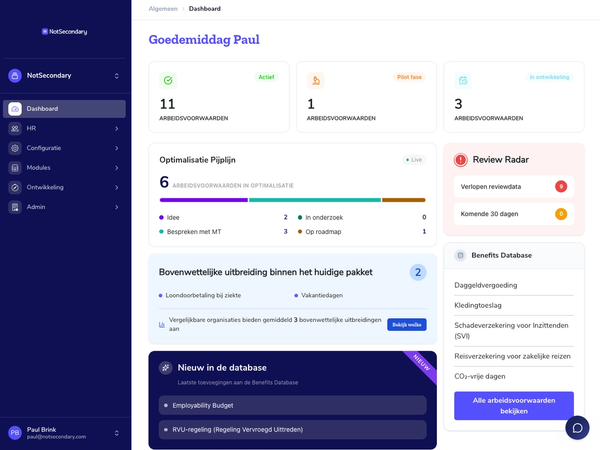
At Not Secondary, we work with this dynamic every day. OurBenefitsDatabasenow contains160+ fully developed benefits, each with22 data points. Think legal, fiscal, and financial implications, as well as the stakeholders you need to involve for each individual benefit.

This database forms the foundation ofTotal Benefits, our SaaS solution. A handy feature: you can add stakeholders directly in the software and actively involve them in implementing the benefits where they have a role to play. This helps you build buy-in, create structure, and maintain control over the timeline.


Latest Insights

Discover the latest articles on secondary benefits and how to deploy them strategically.

Frequently Asked Questions

Find answers to the most common questions about our services and solutions.

Total Benefits is the first Employee Benefits Intelligence Platform in the Netherlands. It helps organisations centralise, benchmark, manage and continuously optimise their employee benefits.

Unlike traditional HR software, Total Benefits is not focused on HR administration or payroll processing. Instead, it is designed to collect, enrich and apply knowledge, benchmark insights and practical expertise related to employee benefits.

At the core of the platform is Benefits Intelligence: the collection, enrichment and application of knowledge, benchmark information, market insights and technology related to employee benefits. This enables organisations to make better-informed decisions about their benefits strategy.

Within the platform you can combine, among other things:

  • the Benefits Database, containing more than 200 fully developed employee benefits, organised across 12 benefit themes;
  • benchmark information and practical market insights;
  • governance and compliance support;
  • optimisation workflows;
  • communication and implementation tools;
  • AI-powered support through the Benefits Assistant.

Total Benefits is not a one-time assessment or a standalone software tool. It is an intelligence platform that supports organisations in building, managing and continuously improving their employee benefits strategy.

As organisations continue to use the platform, they gain increasing insight into:

  • how their benefits compare with the market;
  • which benefits are most relevant to their workforce;
  • where optimisation opportunities exist;
  • which trends and developments are shaping the future of employee benefits.

The goal: helping organisations move from fragmented employee benefits towards better-informed decision-making and a future-proof benefits strategy.

The name Total Benefits is inspired by the well-known HR concept of Total Rewards: the complete value an employer offers employees, including compensation, benefits, development opportunities, company culture and the overall employee experience.

Since our platform focuses specifically on everything beyond base salary, we chose the name Total Benefits.

Within the platform, employee benefits are organised into 12 core benefit themes, including wellbeing, mobility, flexibility, sustainable employability and meaningful work. This creates greater structure, consistency and visibility across the entire employee benefits package.

Built on this central knowledge layer, organisations can not only manage their employee benefits, but also benchmark, optimise and make better-informed decisions for the future.

Benefits Intelligence is the process of collecting, enriching and applying knowledge, data and market insights related to employee benefits.

By combining consultancy expertise, benchmark information, practical market insights and technology, Total Benefits enables organisations to make better-informed decisions about their employee benefits strategy.

Benefits Intelligence forms the foundation of every capability within Total Benefits — from the Benefits Database and benchmark insights to governance, AI-powered assistance and future platform innovations.