The role of stakeholders in the benefits package, Part 3

Benefits affect everyone in the organisation. But not every benefit has the same impact, and not every stakeholder needs to be involved at the same time. A workation, for example, directly concernsIT and Security, while an unpaid leave arrangement is primarily relevant toPlanning and Scheduling.
In this three-part series, I walk you through the key stakeholders in benefits processes:
- Part 1: HR, Leadership & Management, and Communication/Branding
- Part 2: Finance, Legal, IT & Technology, Facilities
- Part 3: Planning, Learning & Development, External Service Providers, Employees/Works Council
For each stakeholder, I explain: when to involve them, what their role looks like, and what to keep in mind when implementing new or revised benefits.
📆 Planning
The facilities stakeholder discussed earlier and the planning function frequently overlap in practice. More and more organisations are counting on a structural percentage of remote workers. At full capacity, the office sometimes turns out to have insufficient space, while at the same time costs are being saved by maintaining fewer square metres.
Planning also plays an important role in benefits such as sabbaticals, unpaid leave, or collective closure weeks. Even with more modern arrangements, such as flexible public holidays, it is essential that planning is part of the conversation. If the office is normally closed on a given day, there must be sufficient work and staffing in place on days that are suddenly opened up.
🧑🏫 Learning & Development
Learning & Development (L&D) encompasses all initiatives aimed at developing the knowledge, skills, and competencies of employees. The goal is both personal growth and organisational success.
Benefits such as study schemes, training budgets, learning platforms, and coaching fall within this domain. L&D therefore plays a key role in connecting strategic goals to individual development and sustainable employability.
📥 External Service Providers
Anyone who takes a close look at an benefits package will quickly see how many external parties are involved. In the area of financial security, this often means pension and insurance providers. Within vitality and development, parties such as Bedrijfsfitness Nederland or Studytube. And in mobility, lease providers for cars and bicycles.
In practice, many organisations work with five or more external service providers, each with their own agreements, contracts, and terms. This makes the benefits landscape not only more complex, but also harder to oversee and manage.
🤝 Employees and employee representation
Perhaps the most important stakeholder of all is the employees themselves. In our work, we engage with them through focus groups and interviews, but ongoing involvement is structured through the works council.
Works councils vary greatly in composition and dynamic. Some are critical and highly engaged with the substance, while others take a primarily constructive approach in working with the employer. Within a single works council, you often find both types: members who bring signals from their immediate environment and members who immerse themselves in collective agreements, benchmarks, and market developments.
In larger organisations, there is sometimes even a dedicated works council committee focused entirely on benefits. With these groups, you can go into real depth and create meaningful impact together.
At Not Secondary, we prefer to involve the works council early in benefits processes. Buy-in from this stakeholder is crucial for a smooth process and well-considered decisions. We also regularly join the table when the works council itself takes the initiative to explore specific themes, such as vitality or flexibility.
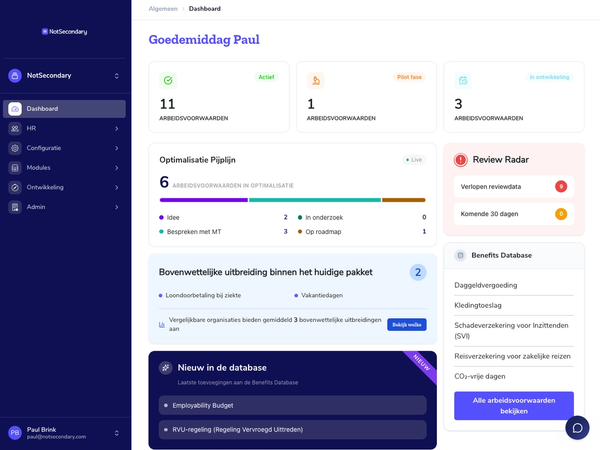
Within our SaaS solution, which has been live since 1 January 2026, it will be possible later in 2026 to add a dedicated module for the works council. With this module, works council members will be able to analyse incoming emails using AI, identify benefits that are generating a lot of questions, and make targeted suggestions for questions in the Employee Voice module. This gives the works council concrete tools to fulfil its representative role more effectively and ensures it is actively involved in the Optimisation of the benefits package. At the same time, it saves a significant amount of time.
From stakeholder analysis to practice
At Not Secondary, we work with this dynamic every day. OurBenefitsDatabasenow contains170+ fully developed benefits, each with22 data points. Think legal, tax, and financial implications, as well as the stakeholders you need to involve for each specific benefit.
This database forms the foundation ofTotal Benefits, our SaaS solution. A useful feature: you can add stakeholders directly in the software and actively involve them in the implementation of the benefits in which they play a role. This helps you build buy-in, create structure, and maintain a firm grip on the timeline.