Total Benefits Update #1 | Q2 2026
Total Benefits is evolving rapidly. During the second quarter of 2026, we introduced several new features and further expanded existing functionality. To keep our customers and everyone interested in Total Benefits informed about these developments, we will publish a quarterly update highlighting the most important changes within the platform.
The purpose of these updates is not only to share new functionality, but also to provide more insight into the decisions we make while developing Total Benefits.
Evolution of our vision, positioning and pricing
From the very beginning, we believed that Total Benefits should be built as an Antibiotic. A platform that doesn't necessarily solve a problem today, but helps organizations make better decisions about their employee benefits package over the long term.
Within the SaaS industry, software is often divided into three categories.
A Painkiller solves an immediate problem. You notice the results almost instantly.
A Vitamin makes work easier or more enjoyable, but it isn't essential to an organization's success.
An Antibiotic takes more time. Its impact isn't immediately visible on day one, but over time it leads to better processes, greater knowledge and more informed decision-making.
That is exactly how we see Total Benefits.
The goal of Total Benefits is not to transform organizations within a single week. Instead, the platform helps employers build a stronger, more consistent and future-proof employee benefits package over time. The longer you use Total Benefits, the more valuable the platform becomes.
Over the past few months, we also realized that our positioning had become much clearer. Total Benefits has evolved into much more than a platform for documenting employee benefits.
That's why we now position Total Benefits as Not Secondary's Employee Benefits Intelligence Platform.
Benefits Intelligence is about collecting, enriching and applying knowledge, data and market insights related to employee benefits. It helps organizations not only document their employee benefits, but also benchmark, manage, optimize and future-proof them.
We've also refined our pricing model. Starting in Q2, Total Benefits is available in three different plans: Foundation, Growth, and Enterprise. This allows us to better serve the wide variety of organizations already using Total Benefits, ranging from employers with a single, straightforward entity to organizations with multiple legal entities, different collective labour agreements and complex employee benefits implementations.
🚀 New in Q2 2026
Configurable Notifications
One of the most common challenges in employee benefits management is that important moments often go unnoticed. Review dates expire, optimization opportunities remain untouched, or colleagues simply don't know that a benefit has been updated.
That's why we've introduced configurable notifications.
Organizations can now decide exactly which events they want to receive notifications about.
Examples include:
- upcoming employee benefit review dates;
- new benefits added to the Benefits Database;
- updates within optimization projects;
- colleagues modifying or bookmarking employee benefits;
- employee benefit anniversaries.
This makes managing an employee benefits package much more proactive.
Benchmark Intelligence
For us, this is perhaps the most significant feature we introduced this quarter.
Many organizations still benchmark employee benefits through standalone research reports or consultancy projects. These are often expensive, time-consuming and provide nothing more than a snapshot in time.
With Benchmark Intelligence, we're taking a fundamentally different approach.
For every employee benefit, we show how the market has implemented it. If a benefit already exists within your organization, you can immediately compare your implementation with similar employers. If you're exploring a benefit in the Benefits Database that isn't yet part of your package, you'll instantly see how other organizations typically implement it.
We believe this approach will ultimately become the new standard for benchmarking employee benefits. Not only because it's faster and more cost-effective, but above all because it enables organizations to benchmark with a level of detail that has never been possible before.
Benchmarking Above-Statutory Benefits
The true value of an employee benefit often lies not in the benefit itself, but in the way it goes beyond statutory requirements.
That's why we previously introduced the ability to indicate whether a benefit has been extended beyond the legal minimum.
In Q2, we expanded this functionality by adding benchmark information.
This allows organizations to answer questions such as:
- Which above-statutory benefits have become the market standard?
- In which areas are we ahead of the market?
- Where are we falling behind comparable employers?
This makes benchmarking more meaningful and better supported by market data.
Governance
Many organizations underestimate the legal risks that can arise when employee benefits are applied for years without proper governance.
Examples include acquired employment rights or situations where changes require approval from the Works Council.
That's why we introduced an extensive Governance module in Q2.
For every employee benefit, organizations can now record:
- whether an acquired employment right exists;
- whether an acquired employment right may exist;
- whether changes require Works Council approval;
- the level of change risk.
The real strength, however, lies in the combination with our notification system.
Total Benefits links governance information to the date on which an employee benefit became active. As a result, organizations can automatically be alerted when a benefit has been in place for years without having been legally assessed.
This helps organizations not only manage their employee benefits, but also proactively manage governance and legal risks.
🔄 Improved in Q2 2026
Benefits Database
During one of our onboarding sessions, a customer made a comment that immediately made us think: of course.
When users searched the Benefits Database for new employee benefits, they could already see whether a colleague had added a benefit to the optimization list. What was still missing was an indication that the benefit was already part of the organization's own benefits package.
A small change, but a major improvement to the user experience.
Sometimes it's exactly this kind of customer feedback that proves to be the most valuable.
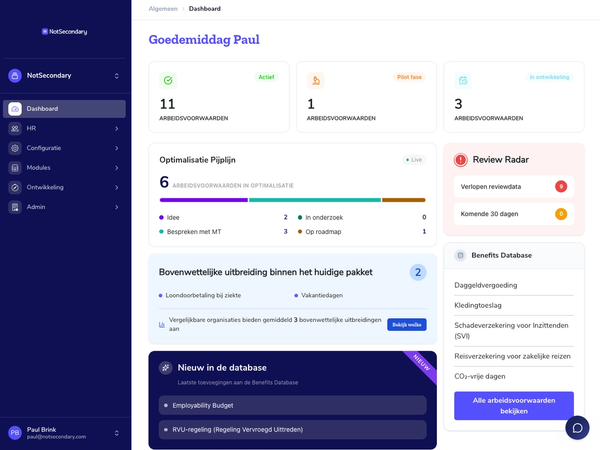
Dashboard 2.0
For many users, the dashboard is the starting point of Total Benefits. That's why we took a close look at which information employers need on a daily basis.
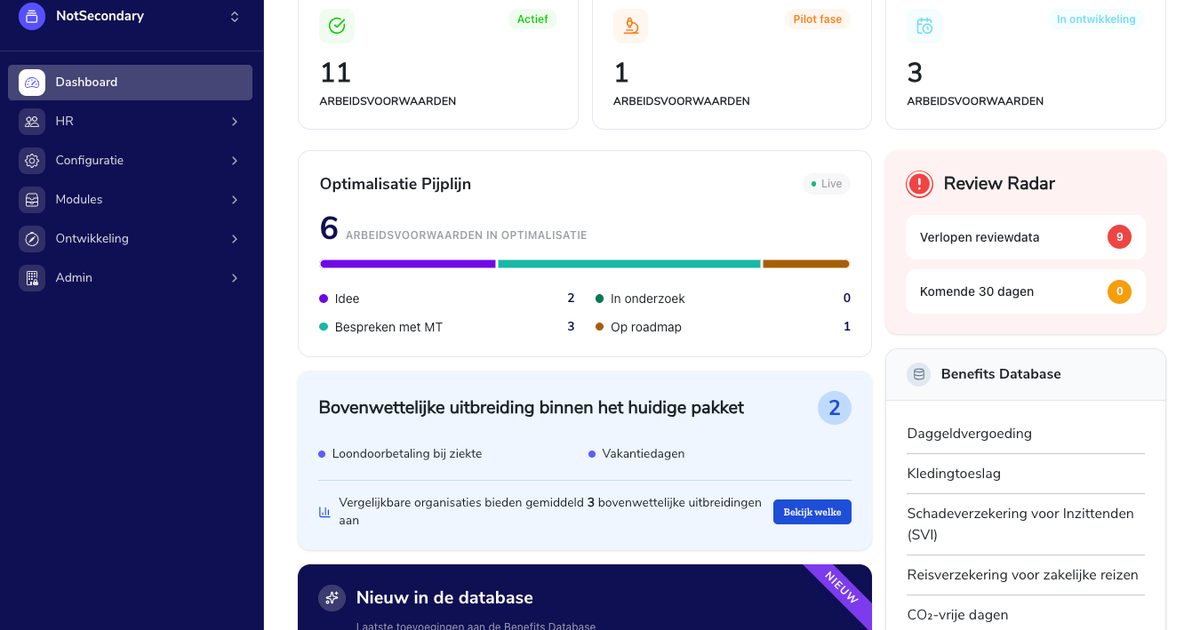
The redesigned dashboard now includes:
- the total number of employee benefits (active, pilot and in development);
- insight into the optimization pipeline;
- benchmarking of above-statutory benefits;
- a review radar;
- a dynamic selection of employee benefits from the Benefits Database;
- notifications about newly added employee benefits.
As organizations continue using Total Benefits and more data becomes available, the dashboard will become increasingly personalized.
Benchmark Intelligence 2.0
Benchmark Intelligence was launched during Q2 and further improved within the same quarter.
Based on user feedback, we've added:
- benchmarking by industry;
- benchmarking by legal entity;
- side-by-side comparison of your own implementation and the market average;
- a clearer visual representation of your market position.
This rapid iteration demonstrates just how valuable customer feedback is to our development process.
👀 Looking Ahead to Q3 2026
We're excited about what's coming in the third quarter.
Benefits Assistant
Employee benefits can be complex.
That's why we're introducing the Benefits Assistant.
Users will soon be able to ask questions about their own employee benefits package. Total Benefits will instantly provide answers, enriched with relevant benchmark information, market insights and direct links to the appropriate modules within the platform.
This will make all information within Total Benefits even more accessible.
Trends
Benchmarking shows you what the market looks like today.
Trends shows you where the market is heading.
Our new Trends module identifies which employee benefits are increasingly being explored, evaluated and ultimately implemented.
This enables organizations to identify developments earlier and make better-informed decisions.
For example, if enhanced bereavement leave is rapidly gaining popularity within your industry, Trends will immediately highlight this. From there, users can navigate directly to the Benefits Database and the associated benchmark information.
In Closing
Q2 was all about deepening the platform.
Not by adding as many standalone features as possible, but by continuing to develop Total Benefits into a platform that enables employers to structurally manage, benchmark, optimize and future-proof their employee benefits package.
We're looking forward to Q3. Not only because of the exciting new functionality ahead, but above all because we'll continue building, together with our customers, what we believe will become the leading Employee Benefits Intelligence Platform in the Netherlands.